
A driver glances at a text message, and someone in a crosswalk dies. A caregiver leaves an infant alone in a bathtub for four minutes. Prosecutors look at facts like these and ask one narrow question. Was this a terrible accident, or was the lapse so far below normal care that the state should file charges?
The short answer: Criminal negligence is a culpable mental state in which a person fails to perceive a substantial and unjustifiable risk. That failure has to be a gross deviation from the care an ordinary person would have used. The law punishes it because the conduct fell so far short of normal caution, not because the person meant to cause any harm at all.
TL;DR: key takeaways
- It sits at the bottom rung of the four culpable mental states used across US penal codes.
- The dividing line with recklessness is awareness. A reckless person sees the risk and goes ahead anyway.
- Civil fault and criminal fault are not the same test, and they use different burdens of proof.
- Charges built on it are usually felonies, but the grade and the sentence differ from state to state.
- One incident can produce a criminal case and a separate civil suit, with different results in each.
The mental state ladder, rung by rung.
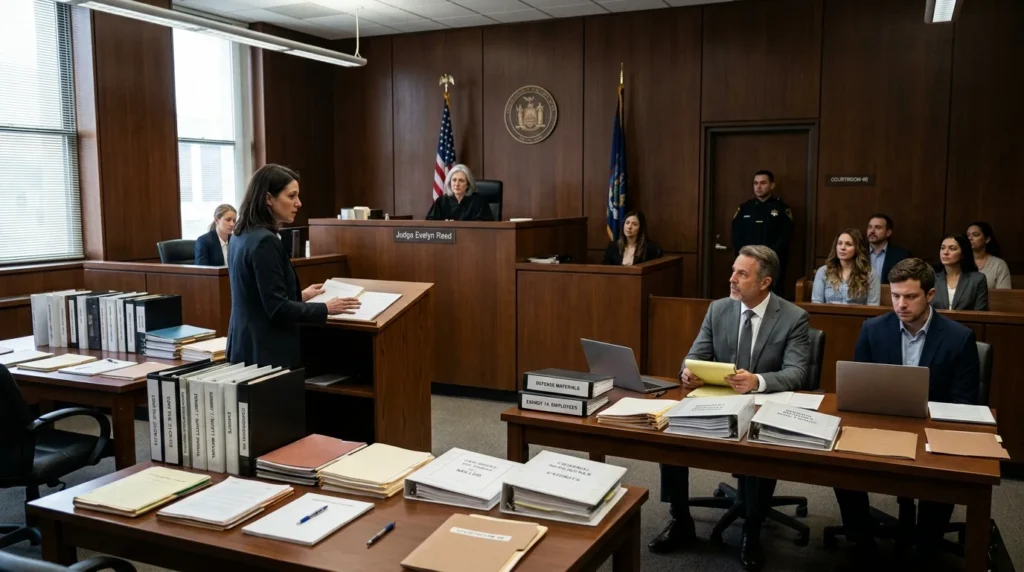
Most state penal codes borrow their structure from the Model Penal Code, which sorts blame into four levels. Prosecutors charge to the rung they can actually prove, and defense attorneys spend most of their energy arguing a case belongs one rung lower.
| Mental state | What the person knew | Plain example | Typical exposure |
|---|---|---|---|
| Intentionally / purposely | Wanted the result to happen | Aiming a gun at someone and firing | Murder, top-tier felonies |
| Knowingly | Knew the result was practically certain | Setting fire to an occupied building | Murder or serious assault |
| Recklessly | Saw the risk and consciously disregarded it | Street racing through a school zone | Manslaughter, reckless endangerment |
| Criminally negligent | Did not see a risk any reasonable person would have | Storing a loaded pistol within a toddler’s reach | Negligent homicide, child endangerment |
The bottom two rungs cause almost all of the confusion. New York writes the split into statute. Under Penal Law 15.05, a reckless person “is aware of and consciously disregards” the risk. A criminally negligent person simply “fails to perceive” it. Same risk, same outcome, different charge. That single word, awareness, is where most of these cases are won or lost, and it is the first thing a defense attorney attacks.
Ordinary carelessness is not enough.
Everyday life is full of small mistakes that would lose a civil lawsuit and never interest a prosecutor. Forgetting to salt an icy walkway is careless. Leaving an unfenced pool open to a neighbourhood full of children is a different order of failure. It is the same instinct that leads parents to fit proper safety gates for a staircase rather than a folding chair.
One word does all the work here, and that word is “gross.” Texas puts it in the code itself. According to the Texas Legislature, Texas Penal Code Section 6.03(d) still defines the term in 2026. A person is criminally negligent when he “ought to be aware of a substantial and unjustifiable risk” that his conduct creates.
Failing to perceive that risk must also be “a gross deviation from the standard of care that an ordinary person would exercise”, in the code’s own phrasing. Juries measure that gap. It has to be wide.
Criminal negligence versus the civil kind

Readers usually arrive at this topic after mixing up two systems that share a word. They are not the same test. Stakes differ too.
| Civil claim | Criminal charge | |
|---|---|---|
| Who brings it | The injured person or their family | A prosecutor on behalf of the state |
| Standard of conduct | Any failure of reasonable care | A gross deviation from reasonable care |
| Burden of proof | Preponderance of the evidence | Beyond a reasonable doubt |
| Outcome | Money damages | Probation, jail, prison, a record |
| Who decides to file | The plaintiff | The prosecutor, sometimes a grand jury |
Both can run at once. One family can sue over a fatal crash while the district attorney pursues charges from the same wreck, and the two proceedings can end in opposite results. Losing the civil case proves nothing in the criminal one, because the jury there needs far more convincing. Long-running matters such as the Murdaugh family’s court history showed the public how civil claims and criminal proceedings travel on separate tracks over several years.
What a prosecutor has to prove
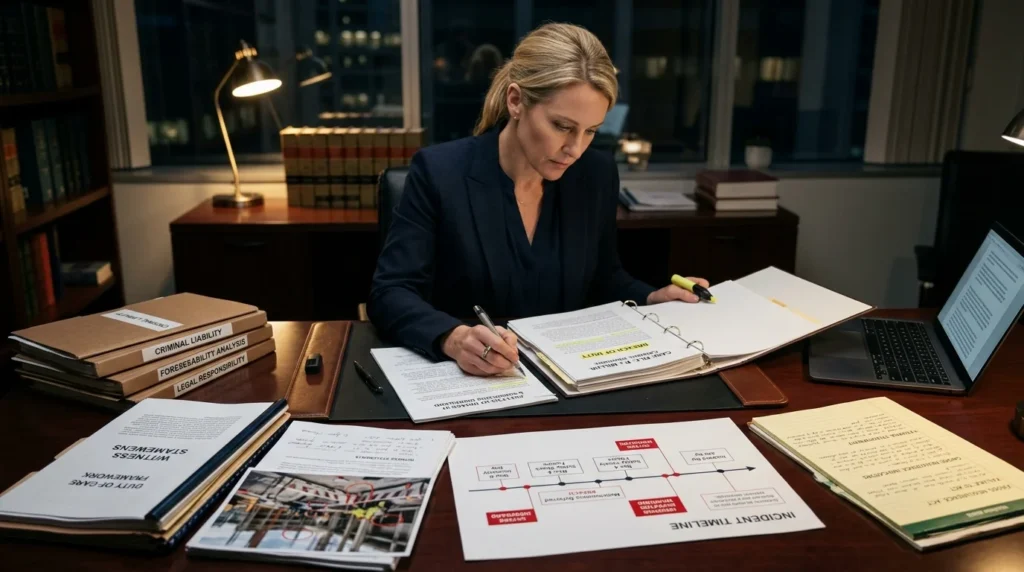
For a criminally negligent homicide count, the state works through a checklist. Each item has to hold up on its own.
- A duty of care. The defendant owed caution to the person harmed, as a driver, parent, employer, property owner,o r licensee.
- A substantial and unjustifiable risk. The danger was real and served no reasonable purpose.
- Failure to perceive it. The defendant did not register the risk, though a reasonable person would have.
- A gross deviation. That failure fell far below ordinary care, not slightly below it.
- Causation. The conduct actually caused the death or injury, without some unforeseeable event breaking the chain.
Miss any one and the charge collapses. That is why so many of these files end in a lesser count, a plea to a misdemeanor, or no charge at all after months of review.
Examples that show up in real dockets
Prosecutions cluster in a handful of settings, and the pattern is consistent: someone held a duty, the danger was obvious, and nobody acted on it.
- Driving. Running a red light at speed in a heavy pickup, or towing an unsecured load. Weight and stopping distance matter, and drivers of a full-size truck like the 2025 Chevy Silverado carry more momentum into a mistake than a compact sedan does.
- Firearms. Leaving a loaded handgun unsecured in a home with young children.
- Child and elder care. Leaving a toddler in a parked car in July, or a nursing facility skipping documented checks.
- Workplaces. Sending crews into an unshored trench or disabling a machine guard to speed up a line.
- Animals. Keeping a dog with a bite history loose after a warning from animal control.
Penalties, and why your state matters
There is no national statute here. Every state writes its own definition, its own offense grades, and its own sentencing ranges, so the identical facts can carry very different exposure across a state line.
New York is a useful anchor. According to text published by the New York State Senate, New York Penal Law Section 125.10 covers anyone who causes anotherperson’ss death through criminal negligence. It grades that offense as a class E felony, which tops out at 4 years in prison under the state’s sentencing rules.
A fine at that grade generally reaches $5,000. Cross a state line and the math changes. Texas grades its own equivalent offense as a state jail felony. Other states fold the same conduct into involuntary manslaughter instead.
Non-fatal versions vary even more. Child endangerment, negligent operation of a vehicle, and unsafe firearm storage can be misdemeanors on a first offense and felonies on a second. Sentences also swing on aggravating facts: a commercial driver, a victim under a certain age, or a prior conviction. Check your own state’s penal code, or ask a local criminal defence attorney, before assuming any range applies to you.
What does not count
Plenty of bad outcomes are not crimes, and this is the part most pages skip.
- An honest mistake. Misreading a label that any careful person could misread is not a gross deviation.
- An unforeseeable event. A medical emergency at the wheel, or a hidden defect nobody could detect, breaks the causation link.
- Hindsight. Juries are told to judge the risk as it looked before the harm, not after.
- Bad judgment inside a lawful activity. Losing a race, a trade, or a game badly is not a criminal act.
Your next step
Facing questions about an incident? Pull up your state’s penal code sections on culpable mental states and homicide. Then speak with a criminal defense attorney licensed where it happened, before you give any statement. If you are here to understand the concept, keep one test in your pocket. Ask whether the person failed to see something obvious, and whether that failure was wildly out of line with ordinary care. That is the whole question a jury answers.
Frequently asked questions
Both, depending on the offense and the state. Homicide versions are almost always felonies, such as New York’s Class E felony. Non-fatal endangerment counts are often misdemeanours on a first offence.
Gross negligence is a civil term for conduct showing reckless disregard, used to unlock punitive damages. The criminal standard borrows the same idea of a gross deviation, then adds the far higher burden of proof.
No. Intent is the top rung of the ladder and is not required here. The state proves what the defendant should have seen, not what the defendant wanted.
Yes. That is exactly what a negligent homicide statute is for, and a sentence of a year or more is common where someone died, even when nobody wanted the outcome.
Prosecutors decide. They weigh police reports, expert findings, and sometimes a grand jury’s view, and plenty of serious accidents get reviewed and then quietly closed with no charge.