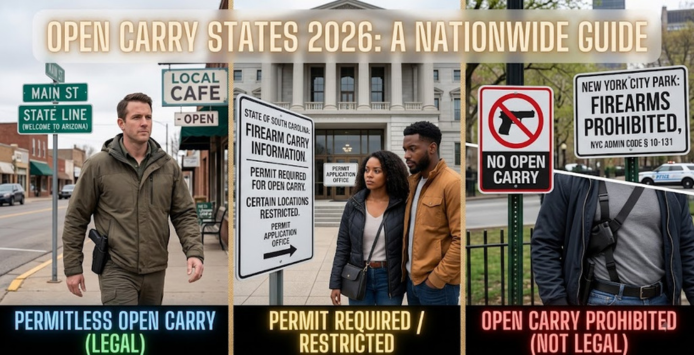
Walk into a Phoenix gas station with a holstered pistol on your hip, and nobody looks twice. Make the same stop four hours west in Barstow, and you have committed a crime. The rule changes at the state line, and no highway sign warns you.
That gap is why generic fifty-state charts fail people. Below, open carry states are sorted into three practical groups, with named examples verified against state sources. It also flags the places where the law moved recently enough that older lists are now wrong.
Short answer: Most states let an adult carry a handgun visibly, and in the majority of those no permit is required. A smaller group issues a licence first and expects you to hold one. California, Illinois, New York, and the District of Columbia bar the practice, and Florida moved to the legal side in September 2025.
The three groups at a glance
| Group | What it means in practice | Verified examples |
|---|---|---|
| No permit required | Any adult who may legally possess the handgun can wear it visibly in most public places. | Texas, Arizona, Georgia, Ohio, South Carolina, Louisiana, Vermont |
| State license required | You apply, qualify, and carry the license with you | Connecticut, Maryland, Minnesota, Rhode Island, Massachusetts |
| Prohibited | Wearing a visible handgun in public is a crime, with narrow exceptions for hunting or your own property | California, Illinois, New York, District of Columbia |
Two cautions before you use that table. It covers handguns, not rifles and shotguns, which several states treat under separate rules. And it is a starting point for research, not legal advice.
Key takeaways
- Three buckets cover the country: no permit, permit required, and prohibited.
- Florida’s ban fell in a court ruling on September 10, 2025, so lists published before that date are stale.
- A concealed carry permit from your home state does not automatically let you carry visibly elsewhere.
- Private property owners can refuse you regardless of what state law allows.
- Schools, courthouses, federal facilities, and bars stay off limits in nearly every state.
- Check your own state’s statute text before you carry, because these rules move every legislative session.
What counts as carrying openly
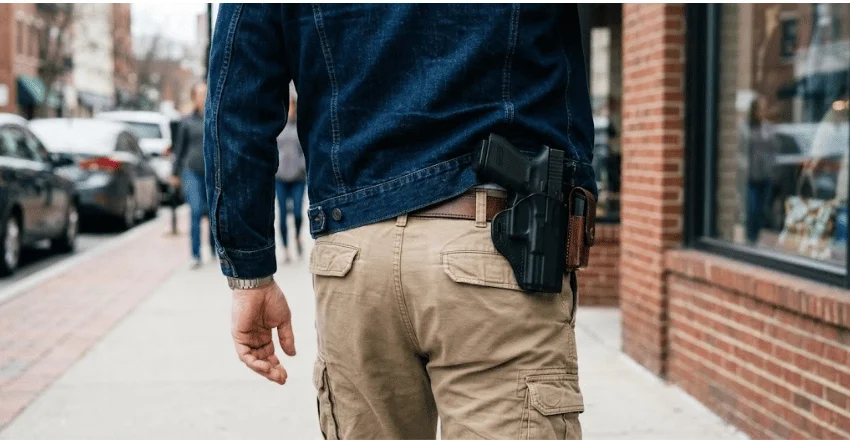
The legal test is usually visibility, not intent. If an ordinary person passing you on the sidewalk could see the firearm, most statutes treat it as carried openly. A holster on the belt is the classic form, though a rifle slung across the back counts too.
Details differ in ways that matter. Some states require a holster rather than a waistband. Some allow the gun loaded; others do not.
Vehicles get their own treatment. Wear a pistol on your belt, and it falls under one section of the state code. Leave it on the passenger seat of a 2025 Chevy Silverado and a different section applies. Several states also restrict loaded firearms inside a car even where belt carry is routine.
States where no permit is needed
This is the largest group, and it has grown steadily since 2021. Texas dropped its permit requirement for eligible adults in September 2021, and Georgia followed in 2022. South Carolina and Louisiana both joined in 2024, which is recent enough that plenty of older charts still show them as permit states.
“No permit” never means “no rules.” You still have to be legally eligible to possess the firearm. That rules out anyone with a disqualifying conviction, an active protective order, or an age below the state threshold. Texas requires the handgun to be in a holster, and several states make it an offense to carry while intoxicated.
People call this constitutional carry, and the label normally covers concealed and visible carry together. Not always, though. Some states allow visible carry without a permit while still requiring a licence to conceal, which is why reading the state’s own statute beats trusting the shorthand.
States that require a permit first
In this second group, the firearm can be worn visibly, but only by someone the state has already licensed. Connecticut, Maryland, Minnesota and Rhode Island all work this way. Massachusetts requires a license to possess a handgun at all, so visible carry there depends entirely on what the issuing authority approves.
Permit conditions vary more than most guides admit. Fingerprinting, a live-fire qualification, a classroom course, and a background check are common, and renewals typically fall every three to five years. Missing a renewal deadline turns lawful carry into an offence overnight.
Where a visible handgun is off the table
California, Illinois, New York and the District of Columbia are the four jurisdictions that prohibit it outright for ordinary civilians. The Illinois State Police put it plainly in their concealed carry guidance: a handgun may only be carried if it is completely or mostly concealed from public view. New York issues a “have and carry concealed” license, and the word concealed is doing real work in that phrase.
These bans coexist with a constitutional right to carry in public. On June 23, 2022, the Supreme Court of the United States concluded in New York State Rifle & Pistol Association v. Bruen that the Second Amendment protects carrying a handgun outside the home for self-defense. That decision struck down New York’s “proper cause” licensing standard. It did not require any state to allow the visible version. All four jurisdictions above chose concealment as their lawful route instead.
Florida changed in September 2025
Florida sat in the prohibited column for decades. On September 10, 2025, the state’s First District Court of Appeal ruled in McDaniels v. State that the ban violated the Second Amendment, and law enforcement agencies across the state stopped enforcing it. The Attorney General’s office issued guidance to prosecutors five days later.
Here is the part almost no list mentions. The banning statute is still printed in the code. As published by the Florida Senate in its 2024 statutes edition, Florida Statute 790.053 still reads that it is unlawful to openly carry any firearm.
Courts halting enforcement is not the legislature deleting the text. Read that section alone, and you reach the wrong conclusion. Check the case law too.
Places that stay off limits everywhere
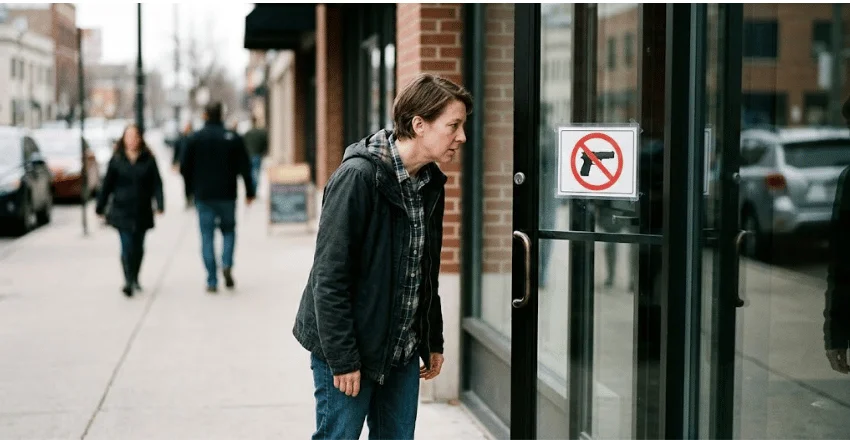
Permission from your state is only half the picture. Federal facilities, secure areas of airports, military installations and post offices are restricted under federal law no matter which state you are standing in. Schools, courthouses, polling places and government meetings are commonly barred by state statute as well. Bars and licensed premises often join that list.
Private property is the rule that trips people up during ordinary errands. Any store, restaurant, or office can refuse entry to anyone carrying, and in many states a properly posted sign carries legal force. Ignoring one usually means a trespassing offense rather than a weapons offense. It is still an arrest. Supermarkets are a frequent flashpoint, and chains from Walmart down to regional operators like Stater Bros have published their own customer firearm policies. Read the door before you read the statute.
Crossing state lines with a visible firearm
Reciprocity is the single biggest misunderstanding in this area. Those agreements between states cover concealed carry permits. They do not create a right to wear a firearm visibly in another state, and a valid permit from home is no defence if the destination bans the practice.
Road trip planning runs in three moves. List every state your route touches, including ones you only pass through. Check each one’s current rule for handguns and for long guns. Then decide whether the firearm travels unloaded and cased under federal transport provisions instead of on your hip.
Do that at the planning stage, not at a traffic stop in an unfamiliar county.
How to verify your state in three steps

- Find your state’s statute by name. Search for the state plus “statute” plus “carrying firearms” and look for the legislature’s own domain, which usually ends in .gov.
- Check for recent court rulings. Florida shows how a decision can override printed text. Your state attorney general’s site is the fastest place to spot official guidance.
- Confirm the location rules separately. General permission and the list of banned places live in different sections of the code, and people read the first and skip the second.
If any step leaves you unsure, ask a licensed firearms attorney in that state. This article is general information, not legal advice, and a wrong guess here carries criminal consequences.
Your next step
Pick the states you actually live in and drive through, then pull each one’s statute and its current attorney general guidance before you carry anything visibly. Bookmark those pages and recheck them once a year, ideally after your state’s legislative session closes. Rules across open carry states shift often enough that last year’s answer is not this year’s, and the person who bears the consequences of an outdated answer is you.
Frequently asked questions
Most of the country permits it in some form, which is why a single number is misleading. A useful split separates states that require no permit, states that require one, and the four jurisdictions that prohibit it. Counts published online often lag behind recent legislation and court rulings.
Yes. Since September 2021, an eligible adult aged 21 or over can carry a handgun in Texas without a permit, and the handgun must be in a holster. Texas still issues a license to carry, which remains useful for reciprocity when travelling.
Yes, following the September 2025 appellate ruling, though the banning statute remains in the published code and the restricted location list still applies. Florida’s situation is the clearest example of a rule that changed faster than the reference pages describing it.
No, not by itself. Reciprocity agreements are written for concealed carry. Some states extend similar treatment to visible carry; many do not, and you have to confirm it destination by destination.
Yes. Private property owners set their own terms and can ask you to leave or to secure the firearm. Refusing that request is where a lawful carrier most often ends up in trouble.
Rifles and shotguns follow separate rules in several states, and a state that allows a holstered pistol may still restrict a slung rifle in public. Check the two categories separately rather than assuming they match.
They stop at the border. United States carry rights have no effect overseas, and many popular destinations treat firearm possession as a serious offense. If your summer plans point to international destinations for June, the firearm stays home and the research shifts to customs rules.