A recusal occurs when a judge steps aside from a case because their impartiality could reasonably be questioned. The issue can arise from a financial interest, family or professional relationship, prior involvement in the matter, personal bias, or other circumstances that could undermine confidence in a fair proceeding.
Understanding when recusal is required, how a party can request it, and what happens if the judge refuses is essential for protecting the integrity of the case. Recusal is the mechanism. This guide walks through the standard, the grounds, the paperwork, and what happens after a judge says no.
The short answer
Recusal is a judge removing themselves from a case because their impartiality could reasonably be questioned. Common triggers include a financial stake, a family tie to a party or lawyer, prior work on the matter, or public comments about the merits. A party can also file a motion asking the judge to withdraw.
The basics at a glance
| Who steps aside? | The judge, justice, or magistrate judge assigned to the case |
| Main federal rule | 28 U.S.C. 455, plus 28 U.S.C. 144 for a sworn bias affidavit |
| Who rules on the request? | Usually the challenged judge, in the first instance |
| Typical Recusal grounds | Financial interest, family relationship, prior representation, personal bias |
| Deadline | Promptly, as soon as you learn the facts |
| If it is denied | Raise it again on appeal, or seek a writ in rare cases |
| Can it be waived? | Only for appearance-based grounds, and only after full disclosure |
Key takeaways
- An objective test applies. It asks what a reasonable observer would think, not whether the judge feels fair.
- Certain grounds are automatic, including any financial interest, however small.
- Your motion normally goes to the judge you are challenging.
- Timing matters. A challenge filed after you lose a ruling looks tactical.
- Appellate courts review a denial with deference, so the record you build now is what you get later.
What Federal Law Really Requires for Recusal
Congress rewrote the federal standard in 1974. Per the text of 28 U.S.C. 455(a), published by the Office of the Law Revision Counsel, a federal judge “shall disqualify himself in any proceeding in which his impartiality might reasonably be questioned.”
Under recusal, read that carefully: it does not say the judge must be biased. It says an outside observer must reasonably question the appearance of impartiality. A genuinely fair-minded judge can still be required to step aside because public confidence in the courts is the interest the recusal rule protects.
Grounds that force a judge off a case
- Financial interest. Any ownership stake in a party or in the subject matter counts, held by the judge, a spouse, or a minor child at home. Size is irrelevant. One share does it.
- Family relationship. A relative within the third degree who is a party, an officer of a party, a lawyer in the case, or a likely material witness.
- Prior representation. The judge worked on this matter in private practice, or a former firm colleague did.
- Government service. The judge advised on the case as a government lawyer, or already voiced a view on its merits.
- Personal bias. Actual prejudice about a party, or firsthand knowledge of facts the parties are fighting over.
Public scrutiny sharpens all of this. Take the South Carolina proceedings that produced years of headlines about the Murdaugh family and the deaths of two of its members. When the defence moved for a new trial, the state supreme court assigned a retired justice to hear that motion. The original trial judge did not rule on it. Reassignment like that is routine housekeeping, and it exists so nobody has to wonder.
Recusal vs disqualification: is there a difference?
Federal practice uses the two words almost interchangeably, and the statute itself is headed “Disqualification.” Many state systems do draw a line. That line is worth knowing before you file.
| Who starts it | Often the judge, acting alone | Usually a party, by written motion |
| Basis | Discretionary or appearance-based | Fixed grounds set by rule or constitution |
| Who decides | The judge | Sometimes a different judge, in states like Texas |
| Waivable? | Sometimes, after disclosure | Frequently not |
Several states also allow one peremptory strike of the assigned judge early in a case, with no reason required. Check your local rules before spending weeks building a bias record you did not need.
How to ask a judge to step aside
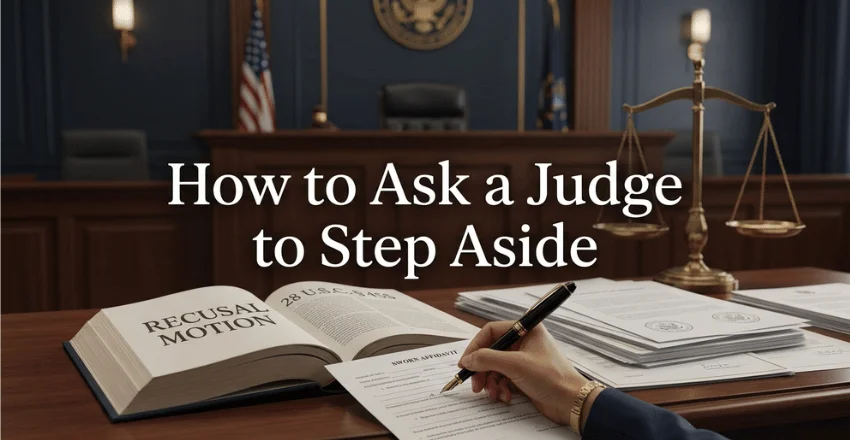
- Collect the facts. Financial disclosure reports, campaign finance records, docket history, and transcripts of what the judge said on the record.
- Pick your vehicle. A motion under 28 U.S.C. § 455 covers appearance and listed grounds. An affidavit under 28 U.S.C. § 144 targets personal bias in a civil or criminal case.
- File promptly. Courts treat delay as evidence that you were holding the issue in reserve.
- Argue the standard, not the outcome. Adverse rulings are rarely biased. Judges rule against people all day.
- Preserve the record. Get the denial in writing or on the transcript, because an appellate court can only review what it can read.
What happens when the judge refuses
Most of these motions fail, and that surprises people. Your request usually goes to the judge you are challenging, which feels circular and is exactly how the federal system is built. Appellate review comes later, and it is deferential rather than a fresh look at the question.
Repeated challenges rarely help. In the Wisconsin trial covered in our piece on the Waukesha parade attack defendant, the self-represented defendant objected to the presiding judge again and again. She stayed on the case, ran the trial to verdict, and the record of those objections went up with everything else.
One caution worth stating plainly: a losing party who never raised the issue at trial has a much harder time raising it after judgment. Silence reads as acceptance.
Campaign cash and the constitutional floor
Most states elect at least some of their judges, which creates a question no ethics canon fully answers. That question reached the Supreme Court on June 8, 2009. Reviewing a West Virginia appeal, the Court concluded in Caperton v. A.T. Massey Coal Co. that due process required a justice to leave a $50 million case. Backing that justice’s election, a party’s chief executive had spent roughly $3 million while the appeal was pending.
By a vote of 5 to 4, the justices agreed. That opinion set a constitutional floor, not a general rule covering every donation to every judicial candidate in the country. Below the floor, state codes and the judge’s own conscience govern.
Do Supreme Court justices follow the same rules?
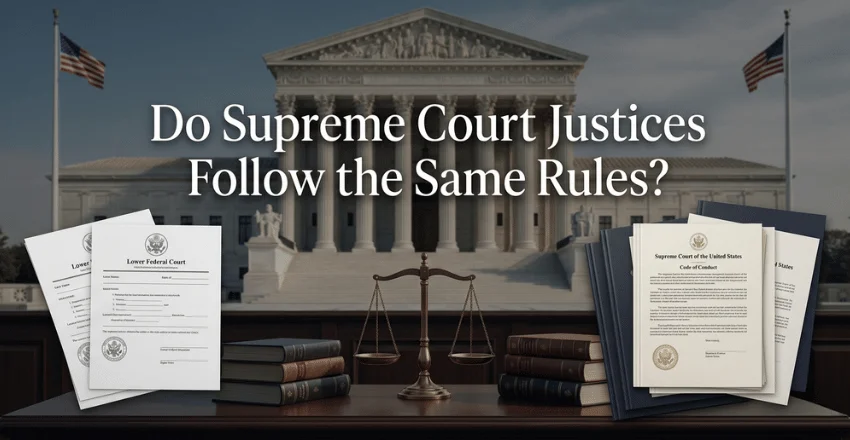
The statute covers justices by its terms, but the enforcement picture differs from the lower courts in two ways. No higher court can review a justice’s decision to stay on a case. And if one justice leaves, no substitute takes the seat, so a 4-to-4 split affirms the decision below.
In November 2023, after a stretch of reporting on undisclosed travel and gifts, the Court adopted its first written code of conduct. That code relies on each justice to apply it. Lower federal judges, by contrast, answer to the Code of Conduct for United States Judges and to circuit judicial councils that can investigate complaints.
Your next step
If you think the judge on your case should not be hearing it, do three things this week. Write down the specific facts and the date you learned them. Pull your Court’s local rules on judicial withdrawal, since deadlines and procedures vary by state. Then talk to a licensed attorney in that Court before you file, because a weak motion is worse than none at all.
Frequently asked questions
Far more often quietly than loudly. Federal courts run automated conflict screens against judges’ financial holdings, so many cases get reassigned before anyone appears in Court. Contested motions are the visible minority.
No. You need facts pointing to an outside source of bias, such as a relationship, an interest, or a statement made off the bench. Disagreeing with rulings is not a ground, and filing on that basis can draw sanctions.
Not always, though written reasons are common in federal Court and helpful on appeal. Judges who withdraw on their own initiative often say only that they are stepping aside, without naming the conflict.
Yes, in narrow circumstances. Courts weigh the risk of injustice, the harm to public confidence, and how much work would have to be redone. A clear statutory violation discovered late has produced vacated judgments before.
Cameras raise the temperature but do not change the test. One 2022 Virginia civil case between two actors, which our coverage of Johnny Depp’s recent years revisits, drew constant commentary about the presiding judge. Public criticism alone is not a legal ground, and the standard still asks what a reasonable observer would conclude from the facts.