Introduction
American Motors Corporation introduced the AMC Gremlin, a subcompact automobile known for its unique, rectangular form and creative approach to economy car production, in 1970. During a period of rising fuel prices and environmental issues, the AMC Gremlin, one of the first subcompact vehicles built in the United States, sought to compete with popular imports by providing a more compact and fuel-efficient alternative. With its divisive looks, the AMC Gremlin car developed a cult following and is still regarded as a prime example of automotive design and marketing brilliance from the 1970s.
Specification: All in One
The AMC Gremlin car came with several engine options, starting with a 2.0-liter inline-four, extending to a more powerful 4.2-liter inline-six, and even a V8 in later models. It featured a three-speed manual transmission, with an optional three-speed automatic available. Known for its compact dimensions and distinctive design, the Gremlin offered practical fuel efficiency, especially appealing during the fuel crises of the 1970s. This subcompact vehicle combined practicality with a unique style, making it a standout in its era.
Design and Styling
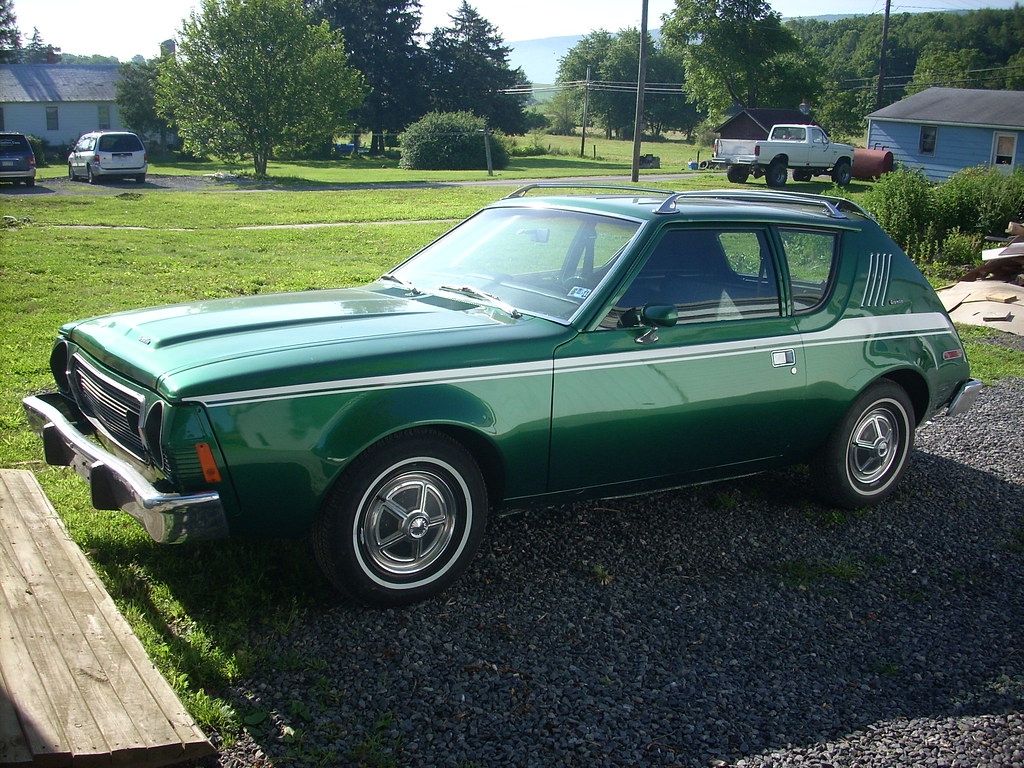
The Gremlin’s unique shape was the brainchild of designer Richard Teague. The original concept stemmed from a scale model of a razed Ford Mustang II prototype. Teague chopped off the rear section, creating an abruptly truncated design that was compact and distinctive. The production Gremlin featured this shortened body with a steep rake from the doors to the rear hatch area. Its low beltline and large glass area provided excellent outward visibility. Two body styles were offered – a two-door hatchback and a two-door sedan with a truncated trunk.
While polarizing, the Gremlin’s design achieved its goal of maximizing passenger space while minimizing overall length. Its styling was controversial yet functional, exemplifying an era of bold experimentation as automakers adapted to changing consumer demands.
Engines
At launch in 1970, the Gremlin was available with two engine options – a 3.8L inline-6 producing 128 hp or the larger 4.2L inline-6 making 145 hp. These powerplants provided adequate performance for the relatively lightweight Gremlin. In 1972, AMC added a smaller 3.3L inline-6 producing 95 hp as a more economical base engine. The 4.2L was replaced in 1976 by a 4.0L inline-6 rated at 120 hp.
Engine Options
1970-1972: 3.3 L I6 (128 hp), 3.8 L I6 (145 hp).
1973-1978: 3.8 L I6 (100 hp), 4.2 L I6 (110 hp), 5.0 L V8 (150 hp).
Transmission
3-speed manual (standard).
4-speed manual and 3-speed automatic (optional).
Dimensions
Length: 161.3 inches.
Width: 70 inches.
Wheelbase: 96 inches.
Performance
While not a performance powerhouse, the Gremlin balanced reasonable acceleration and good fuel economy for its size. An optional X package offered dress-up items like body stripes and upgraded tires, shocks, and anti-sway bars for improved handling.
- Depending on the engine, 0-60 mph: 10-15 seconds.
- Top Speed: Up to 100 mph with the V8 engine.
- Fuel Economy
- City: 18-20 mpg.
- Highway: 24-28 mpg.
Trim Levels
- Base Model: Basic features.
- X Package: Sporty enhancements.
- Gremlin GT: Introduced in 1977, sportier with unique styling.
Interior and Features
The Gremlin’s interior prioritized space efficiency and practicality over luxury. The front buckets and rear bench seats provided reasonable comfort. The back seat was relatively roomy thanks to the Gremlin’s clever packaging. Standard equipment was basic but adequate, with options like air conditioning, AM radio, and rear defogger available to dealers. Hatchback models featured fold-down rear seats for added cargo versatility. While Spartan, the no-frills Gremlin reflected its mission as affordable, efficient transportation rather than an upscale personal car.
- Optional air conditioning, AM/FM radio, power steering, and front disc brakes.
- Interior options included bucket seats and fold-down rear seats.
Legacy and Cult Status
Despite initially poor sales and a lukewarm critical reception, the AMC Gremlin developed a passionate cult following over the years. Its audacious, unorthodox styling made it an unforgettable automotive oddity that couldn’t be ignored. Today, the Gremlin is highly collectible among AMC enthusiasts who appreciate its history as one of the most daring, love-it-or-hate-it designs ever produced by an American automaker.
Retrospective Reviews and Impact
Critical reviews of the Gremlin were mixed upon its release. Some praised its space efficiency, visibility, and affordability. Others lambasted its awkward looks and lack of refinement. Popular Mechanics said, “The a.m.thing falls into the “love it or hate it” category of automotive design.”
- Richard Teague’s daring Gremlin design certainly accomplished AMC’s goal of drawing attention and starting positive or negative conversations. While automakers typically avoid polarizing designs, AMC’s bold gamble reflected its underdog mindset and willingness to take risks.
- From a business perspective, the Gremlin was a modest success that helped AMC stay solvent in a very difficult era. Over its 8-year production run, around 670,000 units were sold – not blockbuster volumes, but enough to justify the program. It attracted new buyers to AMC showrooms and maintained a crucial market share.
Manufacturing
The manufacturing process of the AMC Gremlin car involved precise engineering and assembly to bring its unique design to life. American Motors Corporation (AMC) meticulously crafted each Gremlin, carefully integrating its distinctive features such as the Kammback tail and compact dimensions. Skilled workers meticulously assembled the car, ensuring quality and reliability at every production line step. From stamping the body panels to installing the engine and interior components, AMC’s manufacturing process aimed to create a durable and efficient vehicle that would leave a lasting impression on the automotive landscape.
A Bold Experiment in Compact Car Design
The AMC Gremlin emerged as one of the most distinctive automotive experiments of its era, blending compact efficiency with unmistakable styling. By adapting the platform of a larger AMC model and shortening its overall length, the Gremlin introduced a unique silhouette defined by its long hood and sharply sloped rear end. This unconventional approach helped AMC offer a small car that still delivered the sturdy feel and responsive power associated with American vehicles. Its standout appearance, combined with accessible pricing and practical daily usability, allowed the Gremlin to capture attention in a growing market for economical cars. Over time, its bold design choices and memorable character cemented its place as one of AMC’s most iconic creations.
The pricing of the AMC Gremlin Car
The pricing of the AMC Gremlin varied depending on the model year, trim level, and optional features selected. When it was first introduced in 1970, the base price for a Gremlin started around $1,879, making it an affordable option for budget-conscious consumers. However, as additional features and trim levels were introduced over the years, the price range expanded accordingly.
Base Model Pricing
- 1970: The base price for the AMC Gremlin when it was first introduced in 1970 was around $1,879, making it an affordable option for consumers.
- Trim Level Variations
- X Package: With the introduction of sportier trim levels like the X Package, pricing may have varied, as these offer additional features and styling enhancements for an increased cost.
- Pricing Changes Over Time
- Model Years: Pricing may have fluctuated across different model years due to changes in production costs, inflation, and market demand for subcompact cars.
- Overall Affordability
- Competitive Pricing: Despite potential variations in pricing based on trim levels and optional features, the AMC Gremlin was positioned as a competitively priced subcompact car, appealing to consumers seeking affordability without compromising on style or performance.
Availability
The AMC Gremlin was produced by American Motors Corporation (AMC) from 1970 to 1978, with a total of 671,475 units built over its eight-year model run.
- The Gremlin debuted for the 1970 model year, with production starting on April 1, 1970. It was initially offered only as a two-door hatchback model.
- Body Styles
- For most of its lifespan, the Gremlin was available in two body styles:
- Initial Rollout
- Two-door hatchback
- Two-door sedan/trunk (introduced in 1972)
- The hatchback configuration proved more popular, accounting for around 60% of total Gremlin sales.
Model Years
Here’s a breakdown of Gremlin availability by model year:
- 1970 – Hatchback only
- 1971 – Hatchback only
- 1972 – Hatchback and new sedan
- 1973 – Both body styles
- 1974 – Both body styles
- 1975 – Both body styles
- 1976 – Both body styles
1977 – Both body styles
1978—Final model year, both styles. After trailing off in sales, AMC ended Gremlin production on April 28, 1978, after building just over 670,000 units.
Geographic Availability
The Gremlin was sold across all 50 U.S. states through AMC’s North American dealer network. It was also exported to some international markets like:
- Canada
- Mexico
- Venezuela
- Saudi Arabia
- Europe (in limited numbers)
Approximately 10-15% of total Gremlin production was exported globally outside of the United States.
Surviving Numbers Today
As an affordable, basic compact car, the Gremlin was not considered collectible when new. Many examples were driven into the ground or fell victim to rust and neglect today. Low surviving numbers combined with its cult following among AMC enthusiasts have made nice original and restored Gremlins increasingly difficult to find. According to some estimates, only around 30,000 may still exist out of over 670,000 built. So while the funky Gremlin was not a mainstream sales success in its heyday, its unique design and representation of the 1970s era have transformed it into a collectible automotive oddity that is very hard to acquire today in good original condition.
Comparisons to Other Subcompacts
When it debuted, the AMC Gremlin had several key competitors, including the Volkswagen Beetle, Ford Pinto, and Chevrolet Vega. While these rival subcompacts offered similar affordability and fuel efficiency, none could match the Gremlin’s eye-catching, radically different styling
- The Beetle was conventionally shaped but had an established reputation for economy. The Pinto and Vega featured more traditional three-box designs aimed at compact car practicality.
- In contrast, the truncated, wedge-shaped Gremlin bucked tradition with a shape unlike anything else on American roads. It carved its niche with styling that drew strong reactions – whether loved or hated. This bold uniqueness is what cemented the Gremlin’s place in automotive history.
Ford Pinto
Introduced just a year before the Gremlin, the Ford Pinto was a more traditionally styled compact hatchback and sedan aimed at the economy car market. With its conventional three-box shape, the Pinto looked mainstream and inoffensive next to the Gremlin’s daring, chopped bodywork. However, Pinto suffered an infamous safety scandal regarding its fuel tank design that tarnished its reputation.
Read More:- The Ultimate Guide to Pacer Cars
Chevrolet Vega
Chevrolet aimed at import buyers with the all-new Vegas launched in 1971. Like the Pinto, the Vega featured a more conservative hatchback and notchback designs than the stubby Gremlin shape. The Vega’s aluminum engine suffered problems, while the Gremlin soldiered on with its simple and durable inline-six engines derived from larger AMCs.
Toyota Corolla
The Toyota Corolla was one of the first Japanese compact imports to gain popularity in America during this era. Smaller and more upright than the Gremlin, it featured a conventional three-box sedan design but offered impressive fuel economy, reliability, and value for the money, which lured buyers away from the domestic subcompact competition.
Apart from that if you want to know about “2024 Tacoma MPG” then please visit our “Automobile” Category.
Conclusion
In conclusion, the AMC Gremlin car is a timeless icon of 1970s automotive design, celebrated for its quirky appearance and practicality. With its unique Kammback tail and compact dimensions, the Gremlin offered a distinctive alternative to traditional vehicles of its time. Despite its short production run, the Gremlin’s impact on the automotive landscape endures, making it a sought-after collector’s item and a nostalgic reminder of an era of innovation and creativity in car design.
FAQs
The Gremlin came with a range of engines over its production years, including economical four-cylinder options and more powerful six-cylinder engines. Some versions even offered V8 power, which was rare in subcompact cars.
Its distinctive chopped-rear design and long hood made it visually unlike most cars of its time. The unusual styling helped it become an instantly recognizable classic.
The AMC Gremlin is a subcompact car produced by American Motors Corporation. It was designed to offer small-car fuel efficiency while retaining the personality and performance of American vehicles.
Unlike many small imports, the Gremlin offered a more robust American-car feel, larger engines, and unique styling. These differences helped it carve out its own identity in the compact-car market.
The chopped-rear style allowed AMC to create a compact car quickly by modifying an existing platform. It also helped the Gremlin stand out visually, giving it a bold and unconventional appearance.