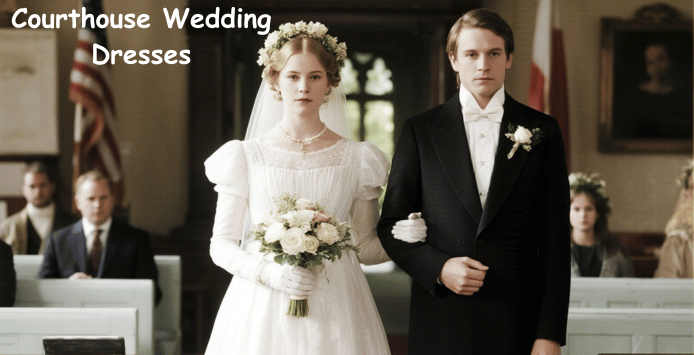
The best courthouse wedding dress is a knee-length, midi, or slip silhouette in silk, crepe, or satin that you can walk into a government building, pass through a metal detector, and sit down to dinner in — no train, no cathedral veil, no structured ballgown. Most civil ceremonies last between three and ten minutes, take place in a plain room with fluorescent overhead lighting, and cap attendance at two to six guests. Your outfit should be built for that reality, not for a cathedral.
The practical range runs from about $80 for a well-cut ASOS or Lulus piece to $600 or more for designer bridal separates, with rentals sitting in the $40 to $150 window. This guide covers silhouettes that photograph well in bad lighting, fabrics that survive a humid August in a building with unreliable air conditioning, the security-screening rules almost nobody warns you about, a realistic budget breakdown, and an alterations timeline that will not leave you pinning a hem the night before.
| Category | Highlights |
| Best silhouettes | Slip dress, sheath, midi, tea-length, tailored jumpsuit, separates |
| Best fabrics | Silk crepe, heavy matte satin, crepe de chine, corded lace, structured cotton blends |
| Fabrics to avoid | Thin polyester satin, tulle-heavy skirts, brocade, anything with a train |
| Realistic budget | $80–$250 for most brides; $40–$150 to rent; $400+ for designer |
| Footwear | Block heels, kitten heels, ballet flats, mules, white ankle boots in winter |
| Ceremony length | Typically 3–10 minutes |
| Guest limits | Commonly 2–6 people, varies by jurisdiction |
| Security screening | Metal detectors and bag checks are standard; large garment bags often refused |
| Alterations lead time | 2–4 weeks standard, 5–10 days rush at a premium |
| Photography | Overhead fluorescent light; matte fabrics and structure photograph better than shine |
What a Courthouse Wedding Actually Looks Like
Before choosing a dress, it helps to know what you are dressing for, because most bridal content is written for a very different event.
You arrive at a municipal or county building, often with a numbered ticket system and a waiting room. You clear security — metal detectors, bag scanners, and in many jurisdictions a ban on outside food, drink, large bags, and sometimes tripods. You wait, sometimes for an hour. The ceremony itself runs a few minutes in a small room or chapel, read by a clerk or judge. Photography inside is frequently restricted to a designated area, and confetti, rice, and petals are almost universally banned. Then you are back on the sidewalk, usually within 90 minutes of arriving.
Three wardrobe consequences follow directly from that:
- You will stand and walk more than you sit. Choose shoes for a mile of city sidewalk, not for a fifty-foot aisle.
- Nothing should drag. Trains, long veils, and floor-sweeping hems catch on carpet tile, elevator thresholds, and metal detector frames. A hem that hits at or above the ankle is genuinely the practical choice.
- You are transporting the outfit through a public building. Anything that requires a garment bag, a dressing room, and twenty minutes of assembly is the wrong outfit unless you have arranged a nearby hotel room to change in.
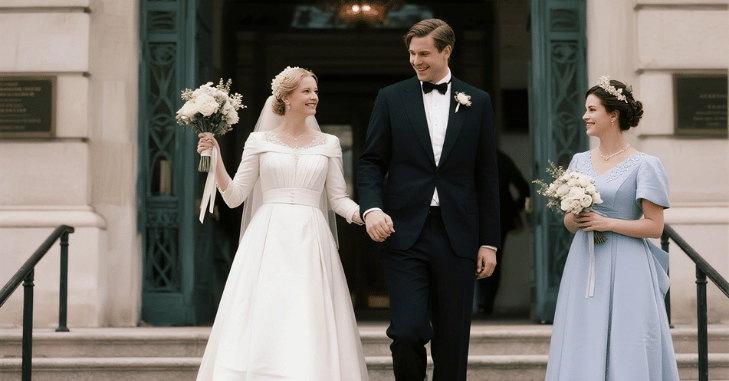
The Best Courthouse Wedding Dress Silhouettes
1. The slip dress
The default for a reason. A bias-cut slip in heavy matte satin or silk skims rather than clings, moves beautifully, and needs almost no styling to look expensive. Look for a bias cut rather than a straight cut — bias hangs from the hip and forgives far more. The trap is cheap high-shine polyester satin, which catches every fluorescent bulb and reads as a nightgown in photographs. If the fabric looks glassy on your screen, it will look worse in person.
2. The sheath or column
Clean vertical lines, minimal seaming, and a hem between the knee and mid-calf. This is the most photograph-proof shape for a room with harsh overhead lighting because it has no volume to cast shadows. It pairs naturally with a single statement earring and nothing else.
3. The midi dress
A hem between the knee and ankle is the sweet spot for civil ceremonies: formal enough to read as bridal, short enough to walk in confidently. Square necklines, cowls, and wrap fronts all work. Pleated midis add movement without volume.
4. The tea-length dress
Hitting mid-calf, this is the vintage-leaning option and works beautifully with corded lace and a birdcage veil for a 1950s reference. It also solves the shoe problem, since a slightly longer hem allows a lower, more comfortable heel without throwing off proportions.
5. The tailored jumpsuit
Wide-leg crepe jumpsuits are the strongest modern alternative and photograph extremely well in urban settings. Two practical warnings: check the bathroom logistics before you buy, and factor in a hem alteration, since jumpsuit legs are almost never the right length off the rack.
6. Bridal separates
A silk camisole or corset top with a matching skirt or wide-leg trousers gives you two pieces you will genuinely wear again, and it solves fit problems for anyone who is a different size on top and bottom. It is also the easiest route to a look that does not read as “wedding dress” if that is not the register you want.
Fabric Guide: What Holds Up Under Fluorescent Light
| Fabric | How it looks | Best season | Watch out for |
| Silk crepe | Matte, dense, drapes without clinging | All year | Most expensive option; water-spots easily |
| Heavy matte satin | Soft sheen, structured, very photogenic | Fall and winter | Shows every underwear line; wear seamless |
| Crepe de chine | Light, fluid, quietly luxurious | Spring and summer | Creases in transit; steam on arrival |
| Corded or Chantilly lace | Textured, romantic, hides the body kindly | All year | Cheap lace looks cheap instantly; check the backing |
| Structured cotton or mikado blend | Crisp, holds a shape, modern | Spring and summer | Wrinkles in the car; pack a travel steamer |
| Thin polyester satin | High shine, clings, reflects harshly | — | The single most common budget-dress mistake |
| Tulle and organza volume | Voluminous and dramatic | — | Impractical through security and in small rooms |
The rule of thumb for a courthouse: matte over shiny, weight over float, and structure over volume. Heavier fabrics hang correctly after two hours of sitting in a waiting room; lightweight ones ride up and crease.
Budget: What You Actually Spend
| Tier | Price range | Where to look | What you get |
| Budget | $50–$150 | ASOS Bridal, Lulus, Abercrombie, Quince | Good silhouettes, fabric quality varies; budget for alterations |
| Mid-range | $150–$400 | Reformation, BHLDN, Astr the Label, Revolve | Better fabric weight, cuts that need less tailoring |
| Designer | $400–$1,200 | Sarah Seven, Jenny Yoo, Theory suiting, Galvan | Silk, real construction, a piece that lasts decades |
| Rental | $40–$150 for 4–8 days | Rent the Runway, Nuuly, local rental boutiques | Designer look, zero storage, no alterations possible |
| Secondhand | $60–$400 | Stillwhite, Poshmark, The RealReal, vintage shops | Best value per dollar; sizing is final sale, so measure carefully |
Then add the costs people forget: alterations at $40 to $150 depending on how much work is needed, shoes at $60 to $180, and a steamer or a hotel pressing charge. A realistic all-in figure for a well-put-together courthouse look sits between $200 and $450 for most people — roughly a tenth of what the average traditional gown and alterations run.
Alterations timeline
- Simple hem: $20–$50, typically 3–7 days
- Taking in a bodice or side seams: $40–$90, 1–2 weeks
- Strap shortening or bust adjustment: $15–$45, under a week
- Jumpsuit leg hem plus torso length: $50–$110, 1–2 weeks
- Rush service: add 50–100 percent, and call first — many tailors refuse rush work in peak season
Order the dress at least six weeks before the date if you can. That leaves room to return one that photographs badly and still get the replacement altered.
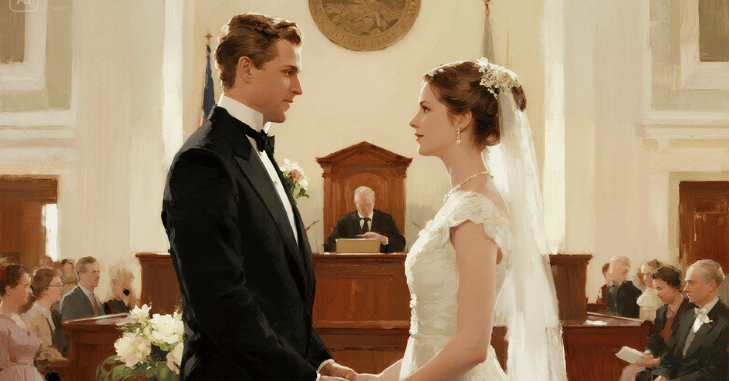
Shoes and Accessories
Footwear is where courthouse brides most often go wrong, because the walking distance is longer than at a traditional venue and much of it is on concrete.
- Block heels, 2 to 3 inches, are the safest choice. They do not sink into sidewalk grates, and they hold up on marble floors.
- Kitten heels give the polish of a heel with almost none of the strain.
- Ballet flats and pointed loafers are legitimately elegant with a midi or tea-length hem and look intentional rather than like a compromise.
- Mules and strappy sandals work in summer but check that the strap does not slip on stairs.
- White ankle boots are the winter answer, particularly with a slip dress and a wool coat.
Break every pair in for at least two indoor hours before the day, and carry blister bandages in the clutch.
For accessories, restraint reads as expensive. A short birdcage or shoulder-length veil, a pearl or fine gold necklace, one statement earring style, and a small structured clutch or box bag is a complete look. A belt at the natural waist is the single most effective way to make a simple sheath look tailored. A cropped blazer or a tailored coat in winter does more for photographs than any amount of jewelry — and if you are pairing the look with something unexpected, our guide to styling a courthouse wedding outfit with sneakers covers how to make that read as deliberate.
Season and Setting
- Summer: Crepe de chine, cotton poplin, or lined linen blends. Municipal buildings are often either freezing from over-air-conditioning or stiflingly warm — a lightweight structured piece with a wrap or blazer covers both.
- Fall: Heavy satin and long sleeves. This is the best season for a tea-length dress with opaque tights and a low heel.
- Winter: Sleeved crepe or a jumpsuit under a proper coat. A cream or camel wool coat is effectively part of the outfit, since most photographs will be taken outside the building.
- Spring: Corded lace and midi lengths. Bring a compact umbrella; the outdoor steps photograph is the shot everyone wants and the weather rarely cooperates.
What Not to Wear
- Anything with a train or a cathedral veil. Impractical through security, and often physically restricted in the ceremony room.
- Strapless dresses that need constant adjusting. You will be standing, waiting, and being photographed from unflattering angles for an hour before the ceremony.
- Very sheer or very short. Some courthouses do enforce basic dress standards, and a judge’s chambers is a workplace. Check your jurisdiction’s posted rules.
- Brand-new shoes. The blister will outlast the memory.
- Heavily creasing linen unless you can steam on site.
- An outfit that requires a bridal party to help you into it. With a two-guest limit, you may not have the hands.
How to Choose the Right Courthouse Dress for Your Body and Day
Silhouette advice only goes so far. The dress that works for you depends on how you want to feel, the building you are marrying in and what you plan to do afterwards. Run through these questions before you buy:
- Where will most photos be taken? If the best light is on the courthouse steps, choose a color and fabric that look good in daylight. If photos are mostly indoors, prioritize matte texture over shine.
- What happens after the ceremony? A dinner or party favors a dress that works into the evening. A quick signing followed by a picnic suits cotton, linen blends or a short dress.
- Do you want to look unmistakably bridal? Ivory, lace and a short veil read as “wedding” instantly. A colored suit or a printed midi reads as celebration without the traditional cue.
- Where do you want structure? A defined waist suits most bodies and photographs well. If you want comfort through the hips, a bias-cut slip or an A-line midi gives room without volume.
- Will you wear it again? If yes, choose a cut and color that fit your everyday wardrobe and skip heavy bridal embellishment.
Quick fit guide by priority
| If you want… | Try | Skip |
|---|---|---|
| Comfort for a long day | Bias-cut slip, wrap midi, wide-leg jumpsuit | Boned corsets, very fitted mermaid shapes |
| A defined waist | Belted sheath, separates with a high-waisted skirt | Shapeless shifts in thin fabric |
| Bust support | Wider straps, square necklines, built-in cups | Thin spaghetti straps with nothing underneath |
| Coverage | Long sleeves in crepe, lace with a lining, high necklines | Unlined lace or sheer panels |
| A modern look | Tailored suit, jumpsuit, minimalist column | Heavy beading and sweetheart bodices |
Color Options Beyond White
A civil ceremony is the easiest wedding setting in which to step away from white. Soft shades such as blush, champagne, pale blue and sage photograph gently under artificial light. Deeper tones like emerald, burgundy and navy look rich in fall and winter and are easy to wear again. A true red is striking on the courthouse steps and pairs well with a classic black suit for a partner. If you want something in between, an ivory dress with a colored shoe, bouquet or lip gives a bridal base with a personal accent. The one color to think twice about is pure bright white in thin fabric, which can look gray and flat in fluorescent light.
Eight-Week Countdown for Your Courthouse Look
- 8 weeks out: Book your ceremony slot and read the courthouse rules on guests, photography and bags.
- 6 weeks out: Order the dress or two contenders, with returns in mind. Order rentals for the correct window.
- 4 weeks out: First alterations fitting. Buy shoes and start breaking them in at home.
- 2 weeks out: Final fitting with the shoes and undergarments you will wear. Confirm hair and makeup plans.
- 1 week out: Collect the dress, steam it and hang it in a breathable bag. Do a full try-on with accessories.
- The day before: Pack your clutch and day-of kit, charge phones and confirm documents.
Day-of kit checklist
- Marriage license and photo IDs, plus any documents your county requires
- Blister bandages, safety pins and a small sewing kit
- Lipstick, blotting papers and a compact mirror
- Stain remover pen and tissues
- Compact umbrella and a light wrap or blazer
- Flat shoes for the walk to dinner if you are in heels
Keep the kit small enough to pass through a bag scanner quickly; scissors and sharp tools may be confiscated at security, so leave them at home.
Undergarments and Fit Details People Forget
Simple dresses hide nothing, so the layer underneath matters more than it would under a structured ballgown. Bias-cut satin and thin crepe show seams, straps and bands, especially in close-up photos.
- Seamless, skin-tone underwear: Choose a shade close to your skin rather than white, which can show through ivory fabric.
- The right bra for the neckline: Bring it to every fitting so the tailor sets strap length and bust darts around it.
- A slip or lining: If the dress is unlined, a simple slip stops cling and makes light fabrics hang properly.
- Anti-chafe balm: Useful on warm days when you are walking between the courthouse, photos and dinner.
- The sit test: Sit down, climb a step and raise your arms in the fitting room. If the hem rides up or the neckline shifts, ask your tailor to adjust it now.
These small checks are what separate a dress that looks good on the hanger from one that still looks right in the last photo of the day.
Coordinating With Your Partner and Guests
The absence of a formal dress code is the freedom, not the problem. What makes courthouse photographs look cohesive is a shared palette rather than matching formality levels. If you are in ivory crepe, a partner in a charcoal or navy suit with a cream or blush tie photographs far better than black-on-white contrast, which blows out in fluorescent light. Both partners in white or cream is a strong modern look. Coordinate metals — if your jewelry is gold, keep cufflinks and watch gold too.
For the two to six people who can actually attend, smart-casual is the right instruction unless you specify otherwise: a dress or separates for guests, a jacket for partners, and no one in white. Tell them the guest limit and the security rules in advance so nobody arrives with a backpack they cannot bring in.
Hair, Makeup, and Nails
| Element | What works for a civil ceremony |
| Hair | Sleek low ponytail, soft waves, a polished chignon, or a good blowout — styles that survive wind and a car journey |
| Makeup | A dewy but not shiny base, defined brows, and either a soft lip or a true red; fluorescent light flattens features, so slightly more definition than usual helps |
| Nails | Neutrals, sheer blush, or a classic French — you will be photographed constantly holding hands and a certificate |
| Fragrance | Apply lightly; small rooms with no ventilation amplify everything |
Sustainable and Secondhand Routes
A courthouse outfit is uniquely suited to secondhand and rental because you are not looking for a once-worn showpiece. Rental platforms let you wear a $900 designer piece for around $100. Resale marketplaces are full of barely worn bridal separates. Vintage shops are the best source for tea-length lace at genuinely low prices, though sizing is inconsistent and alterations should be assumed. And because most courthouse dresses are wearable again, buying one good piece you will wear to dinners and events for years is more sustainable than any single-use gown — the same logic that makes a well-chosen wedding dress in a minimalist cut such a durable purchase.
The Bottom Line
A courthouse wedding rewards editing. Pick a silhouette with clean lines and a hem you can walk in, choose a matte fabric with real weight, get it altered properly, break your shoes in, and keep accessories to three pieces at most. That combination will look better in photographs, feel better across a two-hour civil appointment, and cost a fraction of a traditional gown — while leaving you with something you will genuinely wear again. If you want more style guidance beyond the aisle, our take on Long Hair with Bangs Over 50: Elegant Hairstyles and Expert-Approved and the wider Fashion category are worth a browse.
Frequently Asked Questions
What should I wear to a courthouse wedding?
A knee-length, midi, or tea-length dress in a matte fabric such as silk crepe or heavy satin is the most reliable choice, paired with a block heel or flat you can walk city blocks in. Tailored jumpsuits and bridal separates work equally well. Avoid trains, cathedral veils, strapless styles that need adjusting, and thin high-shine polyester, which reflects harshly under the fluorescent lighting used in most municipal buildings.
Can you wear white to a courthouse wedding?
Absolutely. White, ivory, cream, and champagne are all common and completely appropriate for a civil ceremony. Many brides also choose blush, pale blue, sage, or even a bold red, and none of those are considered a breach of etiquette at a courthouse. The only genuine restriction most jurisdictions apply is a basic standard of coverage, since a judge’s chambers is a working government space, so very sheer or very short pieces are worth reconsidering.
How much should a courthouse wedding dress cost?
Most brides spend between $80 and $250 on the dress itself, with mid-range labels sitting around $150 to $400 and designer bridal separates running $400 or more. Renting costs roughly $40 to $150 for a four to eight day window. Once alterations at $40 to $150 and shoes at $60 to $180 are added, a complete, well-tailored courthouse look typically lands between $200 and $450 all in.
Should I wear a veil to a courthouse wedding?
It is entirely optional and increasingly common. If you want one, a birdcage or shoulder-length veil is the practical choice — it reads as unmistakably bridal, photographs beautifully on the courthouse steps, and does not catch in metal detector frames, elevators, or ceremony room doorways. Cathedral and chapel lengths are impractical in these settings and are sometimes restricted by the building itself.
How long does a courthouse wedding ceremony take?
The ceremony itself usually runs between three and ten minutes. The full appointment, including security screening, check-in, waiting for your number to be called, and the ceremony, typically takes 60 to 90 minutes, though busy urban courthouses on popular dates can run longer. Plan your outfit for standing and waiting rather than for a brief walk down an aisle, and choose shoes accordingly.
Can I wear the same dress to the ceremony and a dinner afterwards?
Yes, and choosing a dress that transitions is one of the main advantages of a civil ceremony. A slip dress, sheath, or midi works for both settings, and swapping the veil for a statement earring plus adding a cropped blazer or heeled sandal shifts the register from bridal to evening in under two minutes. This is also why buying one well-made piece often makes more sense than a single-use gown — you will wear it again.